How to calm and soothe your crying baby?

A baby's crying is a way for them to express themselves, to express their needs and to communicate with those around them; but it can be a difficult time for the whole family, especially at dusk and during the night.
Have you ever heard of the "crying curve"? The first pediatrician to establish this curve was Dr. Hunziker in 1986, and it has since been adopted by others. This model aims to map a baby's crying patterns according to their age: starting 2 to 3 weeks after birth, a newborn's crying increases. Between the 6th and 8th week, their crying intensifies, reaching its peak. The baby cries a lot and intensely. The crying then decreases until they reach 3 months of age. Faced with a baby's cries, as a mother (or father), it's easy to feel helpless and overwhelmed. We'll try to give you some tips and tricks to help you understand your baby's cries , soothe them, experience them more calmly , and contribute to your family's well-being .
Daylily Paris is a brand of clean, sensorial, and effective skincare products, made in France and 100% compatible with pregnancy and breastfeeding. We are also committed to sharing valuable information for an informed and confident motherhood. 🧡
=== Adding product 1 ===
Postpartum Gift Set
=== Adding product 1 ===
The Washing Bubbles
=== Adding product 1 ===
- Why is the baby crying?
- How to identify the causes of a baby's crying?
- How to soothe and calm your baby?
Why is the baby crying?
Crying is a normal phenomenon for infants and babies. As parents, we are not necessarily responsible for it, but our presence is comforting and essential for reassuring the baby . The mother plays a particularly important role in comforting her baby, as she is generally the baby's primary attachment figure.
There are many reasons why a baby cries.
Through his crying and screaming, he expresses his hunger , thirst , pain , discomfort , colic or a state of fatigue .
But that's not all... During the first three months, at the end of the day or in the evening, babies cry quite intensely and then suddenly stop for no apparent reason. Just like you, babies need to release the tension accumulated during the day. These cries allow them to discharge their emotions and are often called " baby meltdowns ." Generally, they are more intense when the day has also been more intense for the baby. For example, a day when they were in a noisy environment. In this case, your presence, as well as rocking, a calming song, and cuddles, are important so as not to leave them alone with their emotions.
Infants can have restless sleep . Just like during the day, they also cry at night to signal their needs to their mother or father. They may experience discomfort that disrupts their sleep; this should be paid attention to, and if it persists and seems abnormal, seek medical advice. It could be an intolerance to formula, or even to breast milk. In that case, you will be advised to follow a cow's milk protein-free diet yourself.
It is also important to pay close attention to certain cries, as they can be a sign of pain or a health problem, and are often accompanied by other symptoms (pale skin, very red mucous membranes, loss of appetite, weight loss, etc.). These cries related to a medical cause represent only 5% of a baby's crying and require an appointment with your pediatrician or doctor.
How to identify the causes of a baby's crying?
Over the weeks and through different techniques, you will learn to better recognize the causes of your baby's crying in order to respond to their needs.
The louder the sound and/or intensity of the crying, the greater your baby's distress.
The Dunstan Method helps identify the cause of crying based on the cries and sounds a baby makes. Priscilla Dunstan was born with perfect pitch, a heightened sense of hearing compared to most people. She was also surrounded by music in the womb and throughout her early childhood. She easily recognizes sound patterns. Thanks to this sensitivity, she hears and distinguishes subtle nuances of emotion in the voices of those she speaks to. When her son was born, understanding his needs through his cries became a priority. She decided to transcribe the sounds and sound patterns of each of his cries, assigning them a phonetic name and noting how she had managed to soothe him. After seeing results with her own baby, she realized that these results also applied to other families she observed on the street and in shopping centers. She then shared her findings, compiled in a chart, with her close circle. This chart quickly spread. Subsequently, she decided to conduct a full-fledged study with her father, a Doctor of Child Psychology and specialist in educational assessment. The results of this study provide you with the key sounds to distinguish among your baby's cries in order to understand the cause and find ways to soothe them.
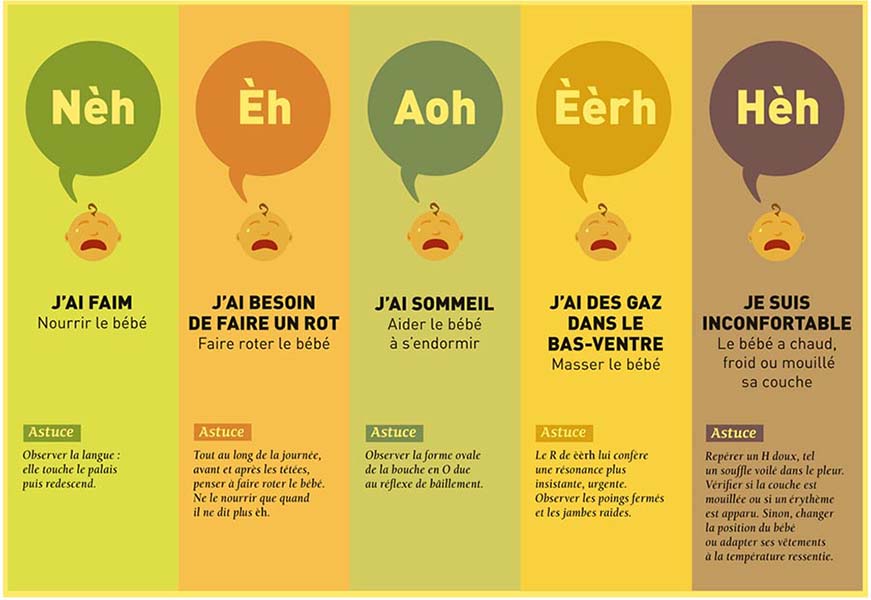
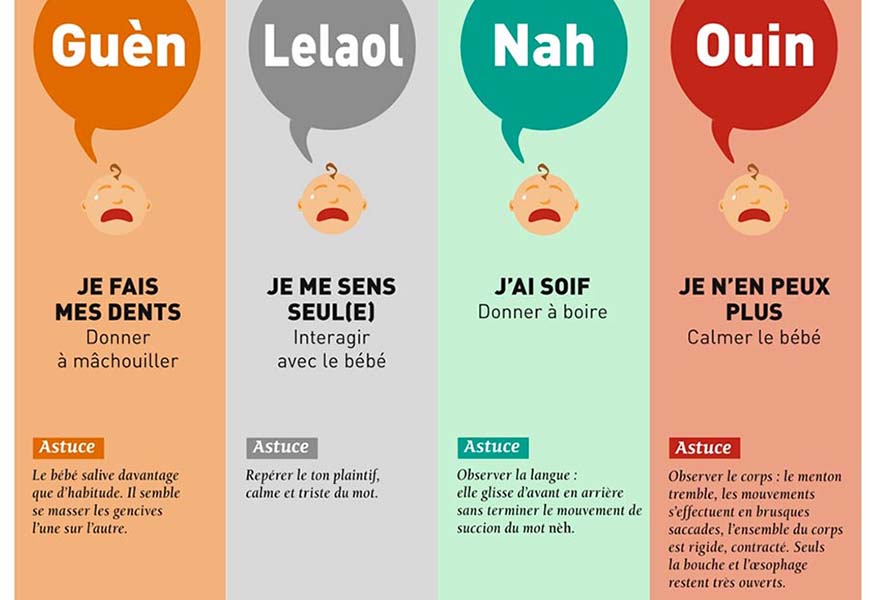
To delve deeper into this subject, we highly recommend reading her book: He's crying, what's he saying? Finally decoding the hidden language of babies , by Priscilla Dunstan.
For those whose ear is not trained enough to distinguish these sounds, the times when your children cry can give you clues about the causes of the crying.
Whether you're breastfeeding or bottle-feeding, your baby may start crying. Perhaps they're no longer hungry, or they have colic. It's also possible they simply need to suckle and not eat. They might also cry if you switch breasts mid-feed. This is because breast milk changes taste during a feeding. Switching breasts will cause a sudden change in taste, and young babies cry to let you know they don't like the change.
He's in your arms and starts to cry. He might be hungry, tired, or have that need to suck again. He might also need stimulation and interaction with you. Something might be bothering him: he's too hot or too cold, his diaper might be soiled...
How to soothe and calm your baby?
You've met your child's needs, but they're still not calming down. Here are some tips and/or tricks to help you soothe them:
- Speak to your baby in a soft and reassuring voice . Your serenity will be contagious.
- Hold your baby in your arms . Infants need close and prolonged contact with their parents. Hold them close, carry them in a baby carrier or sling. Your closeness will help them relax and calm down. Their stress level will decrease, and they will feel secure. Putting your baby in a sling also places them in a position that soothes colic.
- Place him in the Buddha position . This position reminds him of his fetal position and calms him. It's magical for relieving colic.
- Touch your child so they feel your presence, especially on their tummy. A massage will help soothe them. A bath can also calm them.
- Change the environment . Provide your baby with a calm environment with dim lighting and low ambient noise. Too much stimulation from the environment can worsen your baby's crying. Play soft music or white noise, which soothes and comforts babies.
- Wrap him or swaddle him. He will feel secure and it will remind him of the snug space of his mother's womb. He will therefore be calmer.
- Rock your child or go for a walk. Movement soothes the baby and helps them find a rhythm to follow.
- Give him the breast or a pacifier ; this will soothe his sucking need and calm him down. However, if he needs to be fed, give him the breast or a bottle. Furthermore, your close presence will also comfort him.
And finally, a little tip: if you can't calm your baby and the crying becomes unbearable, put on your headphones with soft, soothing music while holding your baby close . You'll be in your own little world, calmer and less stressed by your baby's crying. Little by little, you'll relax, and so will your baby.
By comforting and soothing your baby when needed, you make them more confident . This won't make them a spoiled and capricious child, as old beliefs might imply.
In some cases, your baby will continue to cry despite your best efforts to soothe them. Above all, don't feel guilty ; you're not responsible, and you're still a very good parent . If you're exhausted, don't hesitate to ask your partner or a family member to take over, or simply leave your baby safely and step out of the room for a few minutes to clear your head and return feeling more relaxed.
Photo credit: Sergio VALENAS & Priscilla DUNSTAN